
How to Get a Business License in Dubai for Real Estate in 2026

Introduction
Dubai’s property market provides great opportunities for investors in 2026.

Market forecasts point to stable growth and strong demand from residents.
But launching a licensed brokerage or management firm requires navigating a complex regulatory landscape. You need a business license in Dubai that matches your specific activities.
Many entrepreneurs face information overload and conflicting advice, leading to costly delays. This guide cuts through the noise with a clear, step-by-step roadmap.
For a wider perspective on property hotspots, check out our investing across the Emirates guide.
Ready to secure your license? Connect with Ayaz Salman on WhatsApp for a free consultation.
Understanding the Types of Business Licenses for Real Estate in Dubai
Before you apply, you need to pick the right type of business license in Dubai. Your choice depends on where you want to operate and what services you plan to offer. Let me break this down simply.
Mainland License
A mainland license comes from the Department of Economy and Tourism (DET). This option gives you direct access to the entire Dubai market. You can work with buyers and sellers anywhere in the city.
The catch? For certain real estate activities, you need a local partner. You also need approval from RERA for brokerage work. A trade license from DET typically costs AED 12,000 to AED 20,000 per year, and a Real Estate Brokerage License from the Dubai Land Department adds around AED 12,900. Source
Mainland works best if you plan to serve local UAE clients and want no trading restrictions.
Free Zone License
Free zones like DMCC, DIFC, Dubai South, and Meydan Free Zone offer 100% foreign ownership. That is a big plus for many entrepreneurs.
But here is the thing. Free zone licenses used to restrict you to trading only within the zone or with international clients. That has changed. Free zone companies can now operate in mainland Dubai after getting the right permits from DET.
Still, free zones are ideal if you focus on international investors or want to keep setup costs lower. Our investing across the Emirates guide covers how different zones compare for property investment.
Which License Fits Your Real Estate Activity?
Not all real estate licenses are the same. RERA defines several categories, each with its own rules.
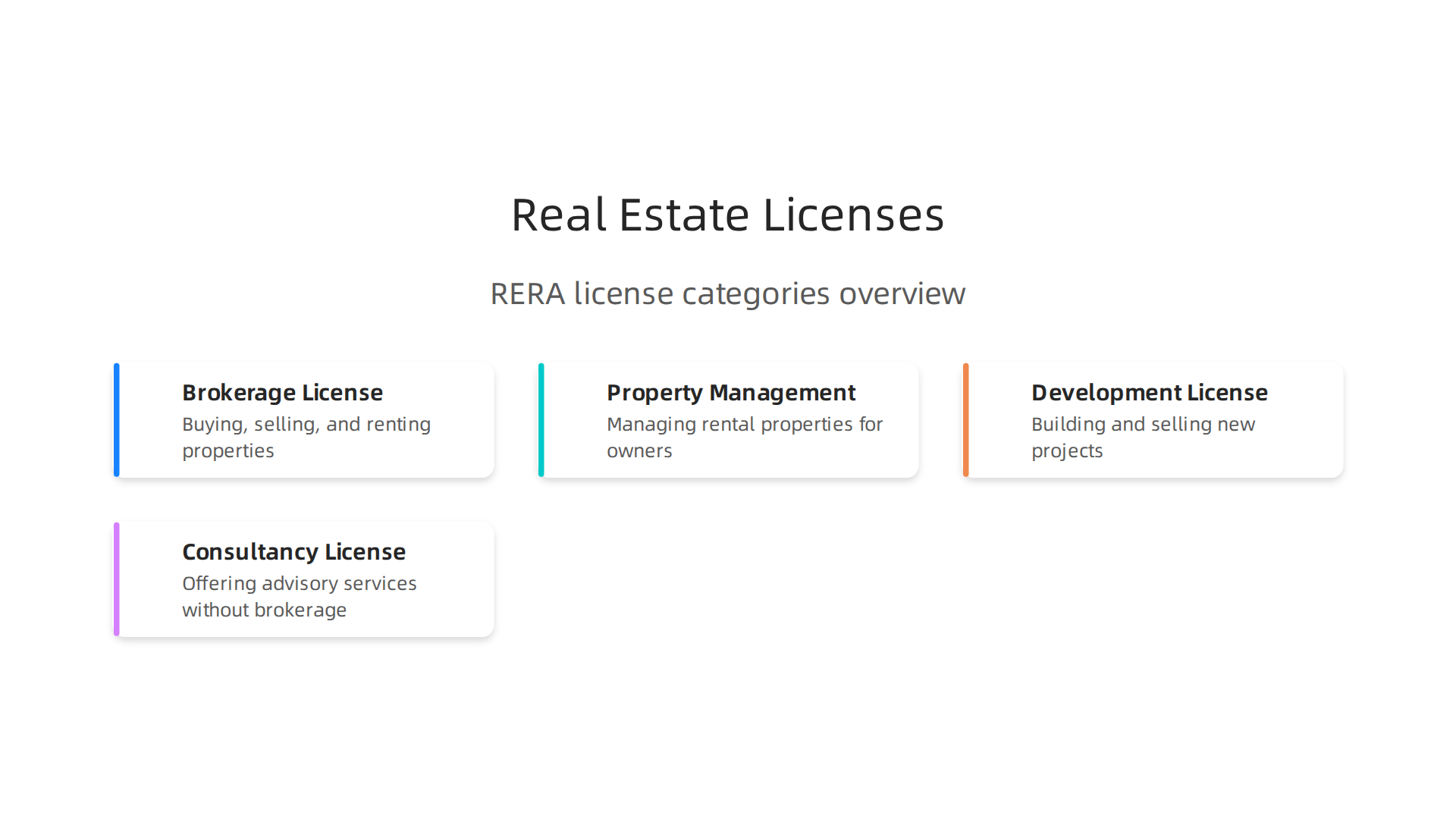
- Real Estate Brokerage License – For buying, selling, and renting properties. This is the most common choice.
- Property Management License – For managing rental properties on behalf of owners.
- Real Estate Development License – For developers building and selling new projects.
- Real Estate Consultancy License – For offering advisory services without brokerage.
Each category requires specific qualifications and approvals. A mainland brokerage license, for instance, needs DET approval first, then RERA certification. Free zone options vary by authority but follow similar principles. Source
Still unsure which license matches your business plan? Connect with Ayaz Salman on WhatsApp for a free consultation. He will help you compare mainland and free zone options step by step.
Step-by-Step Process to Apply for a Business License
Now that you know which license type fits your real estate goals, it is time to walk through the actual application process.
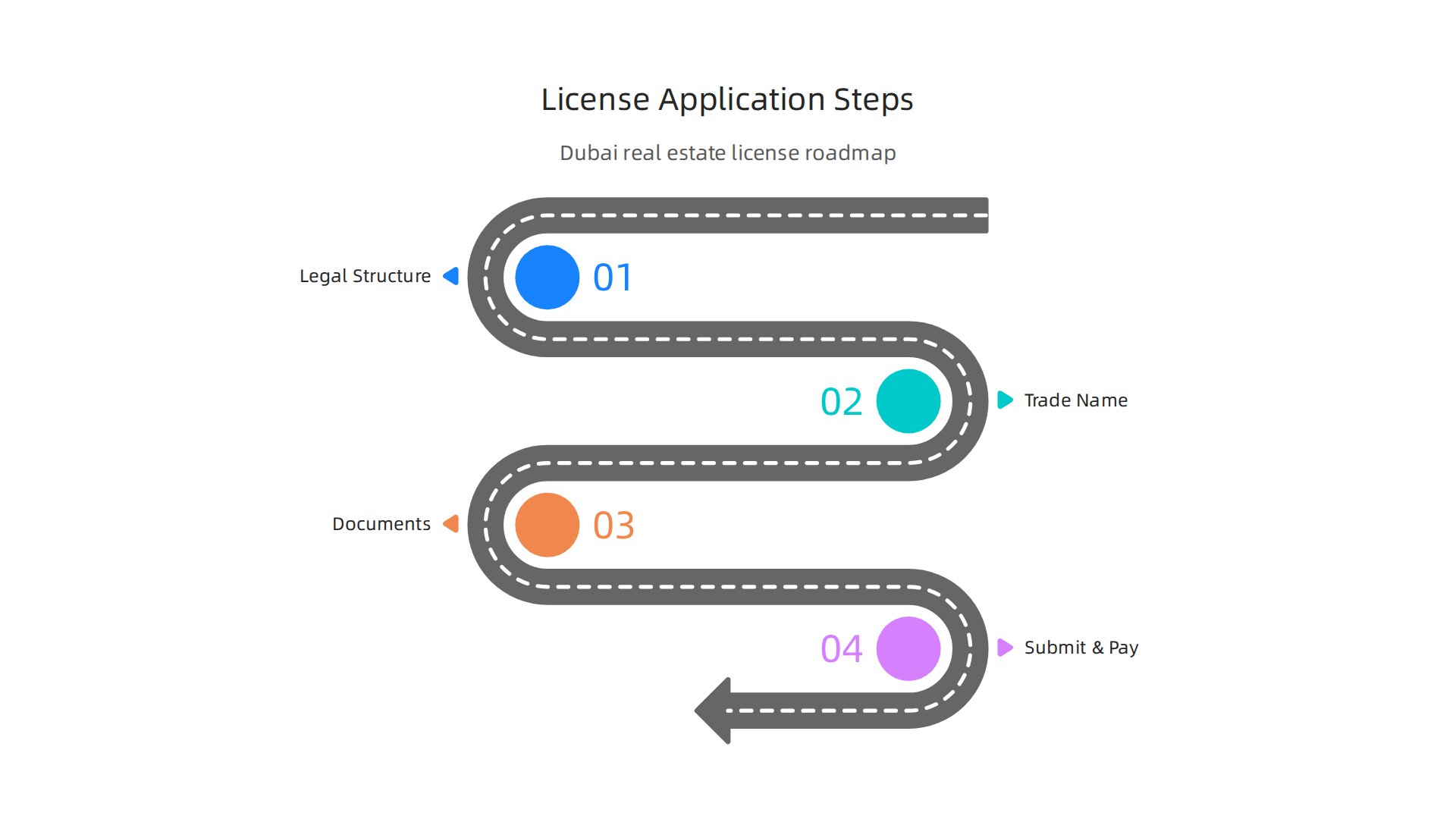
Getting a business license in Dubai involves several clear steps.

Here is how to move from idea to official approval.
Step 1: Choose Your Legal Structure
Your legal structure affects ownership, liability, and how much control you have. The main options are:
- LLC (Limited Liability Company) – Requires at least two shareholders. You may need a local partner if you go mainland.
- Sole Establishment – One person owns and runs the business. You take full liability personally.
- Branch of a Foreign Company – Lets an existing overseas firm operate in Dubai. The parent company is fully liable.
Pick the structure that matches your ownership goals and risk comfort. Many first-timers start with an LLC for flexibility. Source
Step 2: Reserve Your Trade Name and Get Initial Approval
Before you submit full documents, you need to reserve a trade name. This locks in your brand. You submit your name choice to the DET or your free zone authority.
At the same time, apply for initial approval. This tells the government you are allowed to start the process. It is not your final license yet, but it shows you meet the basic requirements. Source
Step 3: Prepare and Notarize Your Documents
This step takes the most time. Gather these key documents:
- Memorandum of Association (MOA) – Outlines your company structure and ownership. Must be notarized.
- Tenancy contract – Proof of a physical office or workspace. The Dubai Municipality may inspect your location.
- RERA pre-approval – If you are doing brokerage work, RERA must approve your activity before your final license is issued.
- Good Conduct Certificate – Proof you have no criminal record. This is required for real estate agents. Source
Also, if you plan to manage properties or develop projects, check whether you need specialized approvals from DLD directly.
Step 4: Submit Your Application and Pay Fees
Now you submit everything through the correct system. For mainland licenses, use the DET portal or visit an authorized center. For free zones, use their own systems.
After submission, pay the fees. Then wait for RERA clearance if you are doing brokerage. Once cleared, you receive your official license.
The whole process takes about two to four weeks if your documents are ready. Delays usually happen because of missing signatures or incomplete forms.
Business setup services in Dubai can handle all this paperwork for you. They save you time and help you avoid common mistakes. Many entrepreneurs choose to hire a consultant for a smoother ride.
Still feeling unsure about any step? Connect with Ayaz Salman on WhatsApp for a free consultation. He can guide you through each stage and help you pick the right business setup path.
Key Legal and Regulatory Requirements for Real Estate License Holders
You have your license. Great job. But now the real work begins. The Dubai government has clear rules for anyone holding a business license in Dubai for real estate.
If you break them, you risk fines or losing your license. Here is what you need to know to stay safe.
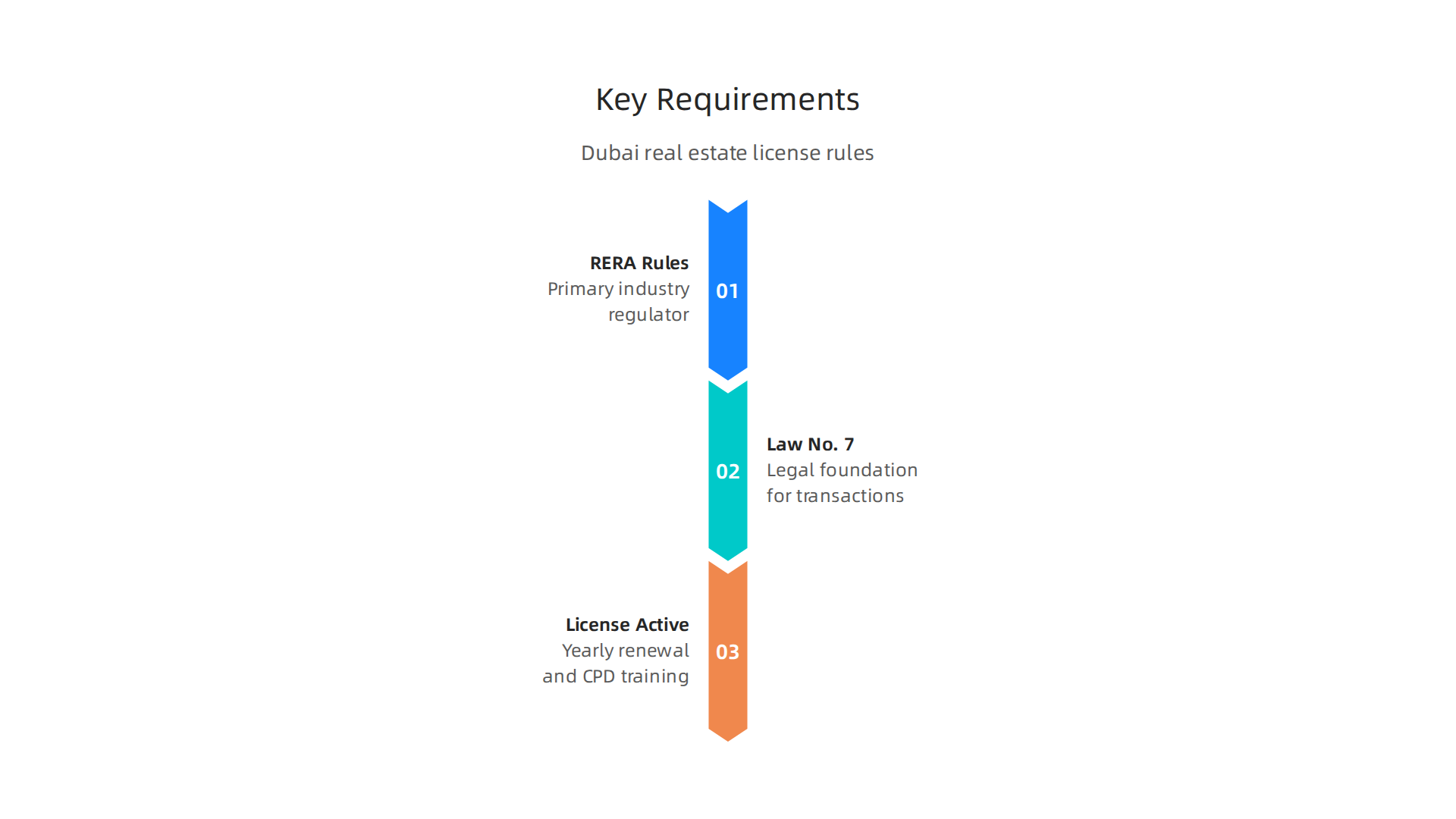
RERA Rules Apply to Everyone
The Real Estate Regulatory Authority (RERA) is the main regulator for the industry. Every real estate firm must register with RERA and get a Real Estate Brokerage Certificate or a Developer Registration. RERA sets strict rules on how you advertise properties and handle clients. This protects buyers, sellers, and agents alike. Source RERA also works to bring transparency to the market. That transparency helps build trust with your clients over time. Source
Know the Law (Law No. 7 of 2006)
This law is the foundation for all real estate transactions in Dubai. It requires developers to use escrow accounts for buyer payments. Your money must go into a special account that protects it until the project is done. For brokers, you must keep client funds in a trust account. You cannot mix client money with your own. These rules protect everyone from fraud and misuse of funds. Source If you plan to work on new developments, always check how these escrow rules apply to your specific project.
Keep Your License Active
Your license needs yearly renewal. To renew, you must complete Continuing Professional Development (CPD) training.
This keeps you updated on new laws and market changes. You also need a clean compliance record. Any past violations can slow down your renewal or block it completely. Using business setup services in Dubai can help you track these requirements and avoid costly mistakes. Source
Staying compliant is not just about following rules. It is about building a trustworthy business that clients can rely on. If you are thinking about expanding your reach, the rules can vary slightly across different areas. You can learn more about these regional differences in our guide on investing across the Emirates in the UAE.
Need help navigating these regulations or finding the right path for your real estate business? We can connect you with experts who understand the local system.
Connect with Ayaz Salman on WhatsApp for a free consultation. He can guide you through the legal requirements and help you make smart moves in the Dubai market.
Costs and Fees Associated with Obtaining a Business License
Now let’s talk about money. How much does a business license in Dubai actually set you back?

The answer depends on where you set up and how much help you need. But here is a realistic breakdown so you can plan your budget without surprises.
Government Fees
These are the unavoidable costs. You pay for initial approval, trade name reservation, license issuance, and RERA registration. For a mainland real estate license, this usually falls between AED 10,000 and AED 30,000. Free zones may start a bit lower, around AED 10,000 to AED 25,000. These numbers come from current 2026 guides. Source Source
Office Rent and Ejari
You need a physical office to get your license. Annual rent can range from AED 15,000 for a small flexi desk in a free zone to AED 50,000 or more for a proper mainland office. You also must register your tenancy contract with Ejari. That costs a small fee but is required by law. Some free zones also ask for a bank guarantee, usually around AED 2,000 to AED 5,000, as security. Choosing a smart location can save you money down the road. For example, a spot near the Al Jadaf Metro station gives you great access at a reasonable rent. Check out our analysis of why Al Jadaf Metro station is a prime property investment in 2026 to see how location affects costs and value.
Hidden Costs You Should Know About
Many first time founders forget about extra fees. Professional fees for legal drafting of your Memorandum of Association can cost AED 2,000 to AED 5,000. Typing services for forms and applications add AED 100 to AED 300 each time. Visa processing for yourself or employees costs roughly AED 3,000 to AED 5,000 per visa. And medical exams for residency are another AED 300 to AED 700 per person. These business setup services in Dubai fees add up fast if you don’t plan for them. Source
If you want a clear picture of what to expect, the best move is to talk to someone who does this every day. We can connect you with experts who will give you a personalized cost breakdown.
Contact Us for free guidance on budgeting your real estate business license in 2026.
Choosing Between Mainland and Free Zone for Your Real Estate Business
So you have an idea of the costs. Now comes the big question: should you set up in mainland Dubai or a free zone?

The answer depends on who you want to work with and how much control you need. Let’s break it down.
Mainland: Freedom to Work Locally
A mainland business license in Dubai lets you trade property directly with any buyer or seller in the local market. That means you can list villas in Palm Jumeirah, apartments in Downtown, or commercial spaces in Business Bay. No restrictions on who your clients can be.
The trade-off? You need a local partner or a natural person as a sponsor. And you must follow RERA rules completely. You also need a physical office with a tenancy contract registered under Ejari. For many brokers, this setup is worth it because you can legally represent both buyers and sellers across Dubai. Source
Free Zone: Full Ownership, Simpler Setup
Free zones like DMCC, Meydan, or DIFC let you own 100% of your company from day one. No local partner needed. Setup is faster. Fees can be lower. But there is a catch. Most free zones restrict your activities to B2B transactions or international clients. You may not be able to directly serve the local retail market unless you get special permits. Source
That said, some free zones like DMCC are popular for real estate trading and property advisory. And recent changes now let free zone companies operate in mainland Dubai after getting the right permits from the Department of Economy & Tourism. Source So the line between the two is getting blurrier.
Offshore Options
Offshore setups like JAFZA Offshore are available but rarely used for active real estate brokerage. They work better for holding assets or managing investments passively. If you plan to actively buy and sell property for clients, stick with mainland or a free zone.
Which One Should You Pick?
Here is a quick comparison to help you decide:
| Factor | Mainland | Free Zone |
|---|---|---|
| Ownership | Requires local partner or sponsor | 100% foreign ownership |
| Client scope | Local and international | Mostly B2B or international |
| Office requirement | Physical office needed | Flexi desk or shared office often OK |
| RERA compliance | Full compliance required | May vary by free zone |
| License cost (annual) | AED 12,000–20,000 + DLD license | AED 10,000–25,000 |
If you want to serve the widest range of clients and build a brand in the local market, mainland is usually the better choice. If you value simplicity, full ownership, and are okay focusing on international deals, a free zone could be your best route.
Still not sure which path fits your business setup plan? That is completely normal. Our team helps people like you compare options every day.
Connect with Ayaz Salman on Whatsapp for a free consultation to choose the right setup for your real estate company.
And if you are thinking about expanding beyond Dubai, check out our guide on investing across the Emirates in 2026 to see how your license can work across the UAE.
Common Pitfalls and How to Avoid Them
You have chosen your path between mainland and free zone. Now comes the execution. This is where many people trip up. Here are three common mistakes and how to avoid them so you can get your business license in Dubai without the headaches.
Choosing the Wrong Activity Code
This mistake happens all the time. The Dubai Land Department uses a very strict list of activity codes. If you select "Real Estate" when you actually need "Real Estate Brokerage," your application will be rejected immediately. This can set you back weeks.
How to avoid it: Look up the exact code on the official Dubai Land Department website before you submit anything. Make sure the description matches your real work. If you feel lost, using trusted business setup services in Dubai can save you from this first roadblock.
Underestimating the RERA Timeline
The approval process for a RERA license usually takes 4 to 8 weeks. You need to complete the training course, pass the exam, and submit all your documents. Many new brokers make the mistake of signing a lease for an office right away. Then they wait months without earning income while paying rent.
How to avoid it: Start your RERA training and exam process first. Do not commit to a long office lease until you have at least conditional approval from the authorities. This one step can save you thousands of dirhams.
Ignoring Office Space Rules
Dubai Municipality and DLD have specific rules for office spaces. If you are applying for a mainland license, your office must meet minimum size requirements. The location also matters. If your space does not pass inspection, your application gets rejected.
How to avoid it: Confirm the spatial requirements for your license type before you sign any rental agreement. Ask your consultant to verify the rules first.
Getting your business setup right takes careful planning. But you do not have to figure it out alone. Contact Us for clear guidance on your application and the next steps.
Once your license is ready, you will want to focus on areas with strong returns. Read our analysis of the Al Jadaf Metro Station area for a top investment opportunity in 2026.
Timeline: How Long Does It Take to Get a Business License?
You already know the common mistakes. Now let’s talk about timing. How long does it actually take to get a business license in Dubai? The answer depends on your path and a few other factors. But here is a realistic look at the timeline so you can plan ahead.
For a mainland real estate license, expect 6 to 10 weeks from start to finish. This includes submitting your application, getting approval from the Dubai Land Department and RERA, completing the training course and exam, and passing your office inspection. The official real estate license company formation guide for 2026 confirms that the full process involves multiple stages that take about two months.
If you choose a free zone, things can move a little faster. A basic free zone license might take 3 to 6 weeks. But here is the catch: you still need RERA clearance to work as a real estate agent. That adds another 2 to 4 weeks. So your total timeline often ends up similar to mainland, around 6 to 10 weeks as well. The cost breakdown for Dubai business setup explains that free zone costs are lower, but you must factor in the extra approvals.
Several things affect how fast your business setup goes:
- Completeness of documents. Missing papers will stop your application cold.
- Local partner availability for mainland license. If you need to find a partner first, that takes time.
- Type of real estate activity. Some activity codes need extra approvals.
To speed things up, prepare every document before you apply. A little planning saves weeks of waiting. When your license is ready, you can start exploring areas with strong returns. Read our guide on investing across the Emirates in UAE 2026 for more ideas.
Need help moving faster? Contact Us for one-on-one guidance on your application and timeline.
Frequently Asked Questions About Real Estate Business Licenses
You made it through the timeline. Now let’s clear up a few common questions people ask about getting their business license in Dubai for real estate.
Can I own 100% of my real estate brokerage on the mainland?
Great question. If you are a UAE national or a GCC national with a professional license, yes, you can own the full business. But if you are a foreigner, you need a local partner who holds 51% of the shares. That is the rule for mainland companies. The EBMS guide explains the ownership structure clearly. If full ownership matters to you, a free zone is an option, but remember you still need RERA approval to operate in Dubai.
Do I need a physical office?
Yes, absolutely. Both mainland and free zone licenses require a real physical workspace. Virtual offices are not allowed for real estate activities. The Real Estate License Dubai guide from Property Finder confirms this. So plan for rent and a proper office setup. That office also needs to pass inspection from RERA before you can start.
Can I convert my free zone license to mainland later?
You can, but it is not a simple switch. You will have to submit a totally new application for a mainland license. Then close your free zone entity. It is basically starting over, though you can reuse some documents. That is why many people choose their jurisdiction carefully from the start. If you already have a free zone license and want to move, our guide on investing across the Emirates may help you weigh options.
Still have questions about your specific situation? Connect with Ayaz Salman on WhatsApp for a free consultation. He can walk you through the details and help you pick the best path for your business setup.
Summary
This guide walks you through everything needed to legally start a real estate business in Dubai in 2026, from picking the right license to staying compliant after launch. It explains the differences between mainland and free zone licenses, the common license categories (brokerage, property management, development, consultancy), and the practical steps: choose a legal structure, reserve a trade name, notarize documents, secure a physical office, obtain RERA approvals and submit your application. The article details government and hidden costs, typical timelines (usually 6–10 weeks), and mandatory requirements such as escrow rules, trust accounts and CPD for renewals. It highlights frequent setup pitfalls—wrong activity codes, underestimating RERA timing, and office rule mistakes—and shows how consultants can speed the process. After reading, you will know which license matches your business model, how much to budget, and what actions to take next to get licensed and compliant.