
Use the Makani Number Dubai to Pinpoint Property Entrances in Seconds

Introduction: Why Precision Matters in Dubai Real Estate
Finding the right property in a city growing as fast as Dubai starts with knowing the right location.

Neighborhoods here cover massive areas. A place like Dubai Land is huge. Arjan Dubai has dozens of new buildings going up every year. Even looking for apartments for sale in Business Bay can feel overwhelming when you are trying to figure out exactly where each building is.
A regular street address just does not give you enough detail anymore. This is where the makani number dubai system changes everything for buyers and investors.
Think of a Makani number as a super specific home address. It is a 10-digit code created by Dubai Municipality. The code pinpoints the main entrance of any building with amazing accuracy, right down to one square meter. This system was built to solve the confusion of hard to find locations and complicated street names in such a fast growing city. It takes the guesswork out of your property search before you even step outside.
Using this smart addressing tool is essential for anyone serious about real estate in 2026. It helps you confirm the exact spot of a building before you commit your time or hard earned money. Whether you are an investor, an agent, or a future tenant, precision saves you from costly mistakes.
In this guide, we will walk you through the best digital tools to use Makani numbers. We will also cover smarter ways to search for properties and the key legal points you need to watch out for. If you are planning to expand your portfolio or buy your first home this year, it helps to understand the full market landscape first. Get a broader view of the opportunities by checking out our Investing across the Emirates in UAE 2026 real estate guide. Let’s dive into how this simple 10-digit code makes finding property in Dubai so much easier.
Understanding the Makani Number System
So what exactly is a Makani number? It is a simple 10-digit code created by Dubai Municipality.
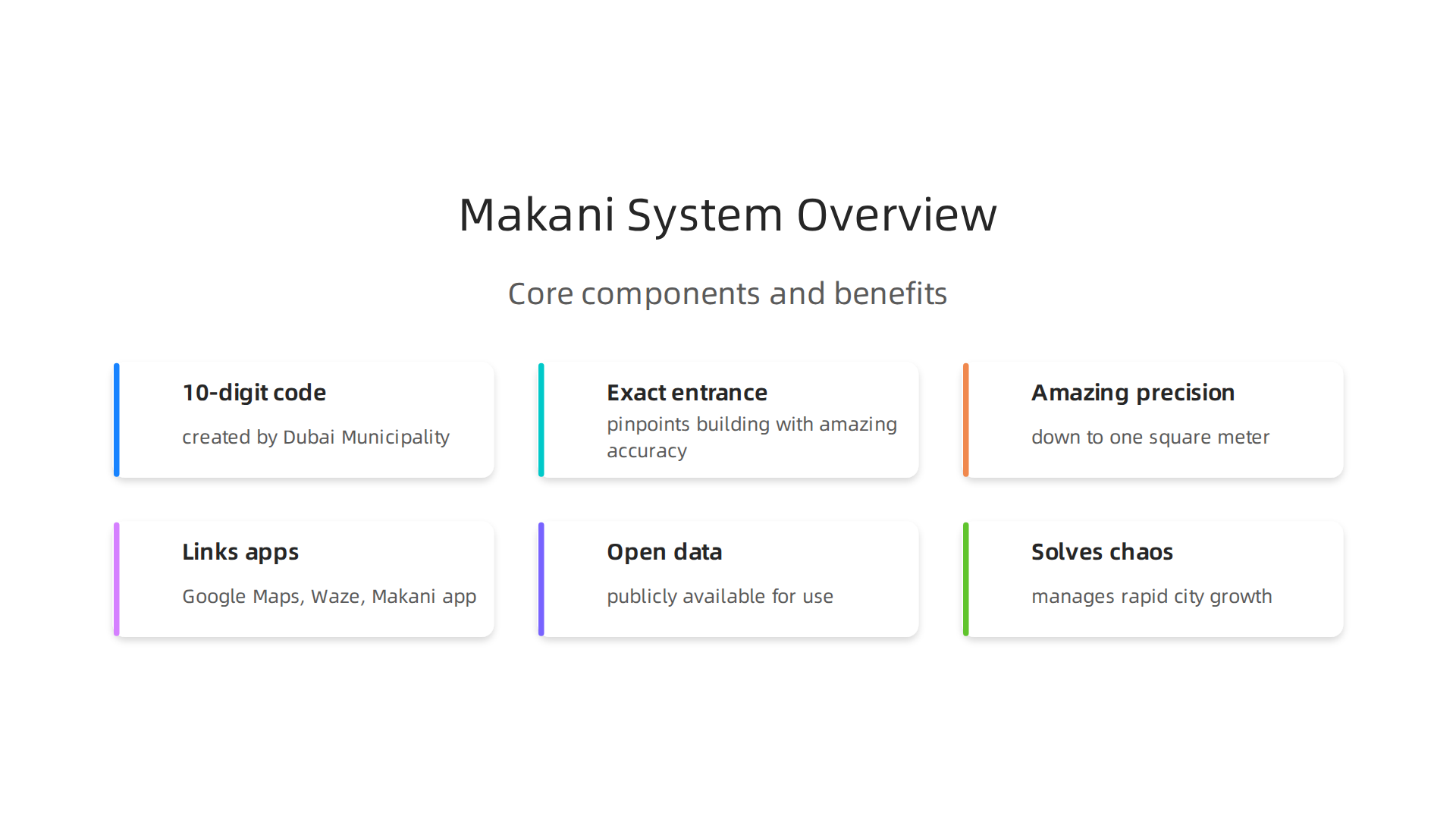
This code marks the exact entrance of any completed building in the city. And it does this with amazing precision down to one square meter. Think of it like a custom ID for every building’s front door. In fact, Dubai became the first city in the world to use this kind of smart addressing system Learn more about how Dubai pioneered Makani numbers.
Before Makani, you might have had to rely on vague street names or landmarks that were hard to find. Now, with this 10-digit code, you can locate a building instantly. The system was built to solve the chaos of a rapidly growing city. It links directly to search platforms and navigation apps. You can enter the code into Google Maps, Waze, or the official Makani app and get turn by turn directions to the exact spot. The official app is available for both iOS and Android, making it easy for anyone to use.
This system is not just for individual use. Developers, real estate agents, and government bodies all rely on Makani numbers for accurate property references. When a listing online says a unit is in a certain building, the Makani number confirms that building’s precise location. No more guessing if the address is right or if you will get lost on the way. Dubai Municipality even offers this data as open information for everyone to use, share, and build upon Access official Makani data from Dubai Municipality. This openness helps both big businesses and everyday buyers work with reliable location data.
Why does this matter for you as a buyer or investor? It takes the guesswork out of your property search. Whether you are searching for properties in Dubai Land, Arjan Dubai, or apartments for sale in Business Bay, having the Makani number means you know exactly where to go before you visit. You can compare two listings in the same area and see how close they really are to schools, metro stations, or shopping centers.

That kind of precision saves you time and helps you avoid costly mistakes. For instance, if you are looking at properties near the Al Jadaf metro station, you can use the Makani number to see exactly which buildings are within walking distance. Check out our guide on why Al Jadaf metro station is a prime property investment in 2026 for more on that area.
In short, the Makani number system turns a regular address into an exact spot on the map. It is a tool that every smart buyer, seller, and investor should use in 2026.
Top Digital Tools for Property Search in Dubai
Now that you understand the Makani number system, you might wonder where to actually use it. The good news is that most major property search platforms in Dubai now integrate Makani numbers right into their listings. This makes finding a property faster and more accurate than ever.
The top three platforms that dominate the market are Property Finder, Bayut, and DXBinteract.
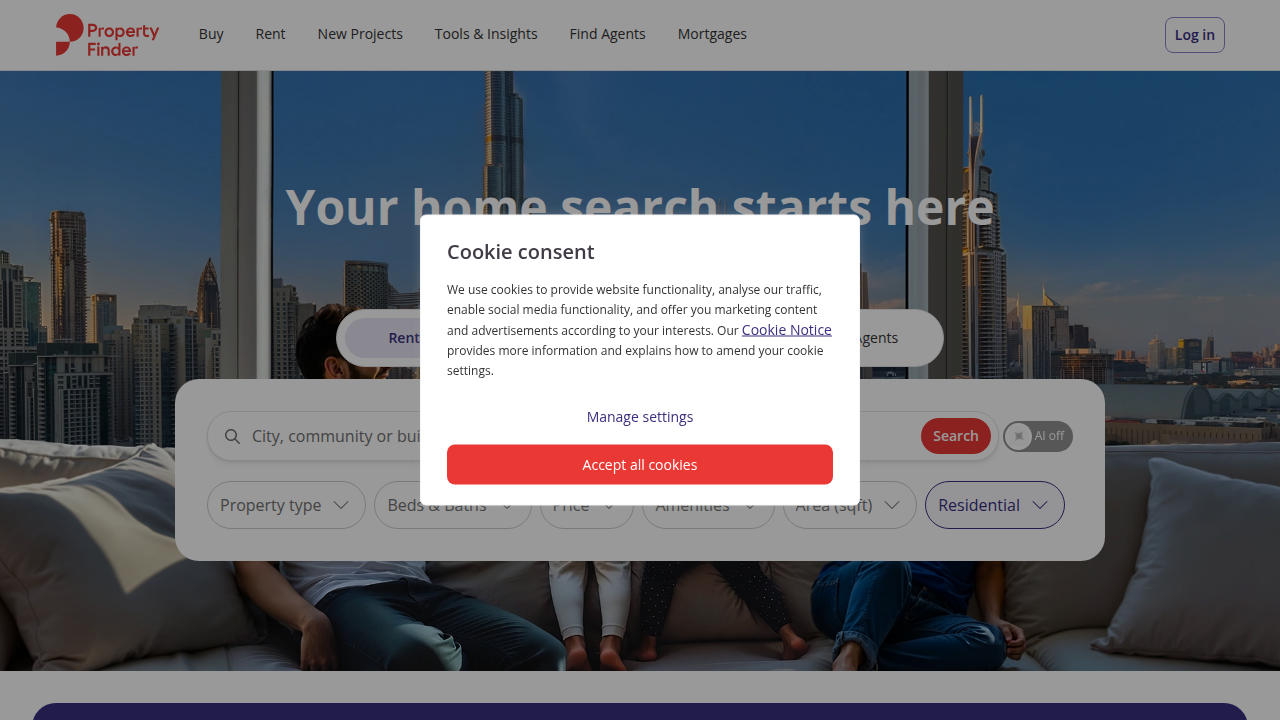
According to recent data from Semrush, these sites consistently rank among the most visited real estate websites in the UAE Source: Semrush top real estate websites UAE. But what sets them apart in 2026 is how they use Makani numbers.
Property Finder is probably the most well-known platform. With over 350,000 listings across the UAE, it lets you filter by location, budget, lifestyle, and commute See the Property Finder app on Google Play. When you open a listing, you will often see the Makani number for that building entrance. Tap it, and the app takes you straight to the exact spot on the map. No more guessing which tower is which.
Bayut offers a similar experience. Its map view is very clean. You can zoom into any neighborhood, like Dubai Land or Arjan Dubai, and see available properties with their Makani codes displayed. This helps you compare how close two apartments really are to the nearest metro station or supermarket.
DXBinteract stands out for investors. It provides interactive charts and price change data for the whole Dubai market Track Dubai real estate prices on DXBinteract. While it is more data-heavy, it also includes Makani numbers for many listings. You can cross-check the price history of a building using its Makani code. That is a powerful tool for making smart investment decisions.
Mobile apps make this even easier. Both Property Finder and Bayut have apps that send real-time notifications when new listings match your saved search. You can browse properties on a map while you are out and about. The Makani number is often just one tap away, showing you the exact entrance. This is especially helpful if you are searching for apartments for sale in Business Bay or other busy areas where buildings can be hard to tell apart.
If you are serious about investing in Dubai real estate, combining these digital tools with Makani numbers gives you a huge advantage. You can verify locations instantly, avoid misleading listings, and save hours of driving around town. For example, if you find a property in Arjan Dubai, you can use its Makani number to check how far it is from the nearest park or school.
Want to take your search beyond Dubai? Read our guide on investing across the emirates in UAE 2026 to see how Makani numbers help in other cities too.
In short, these platforms are not just listing databases anymore. They are precision tools that put the power of the Makani number system right in your pocket. Use them together, and you will find the perfect property with confidence.
How to Use the Makani Number for Exact Property Location
So you have a Makani number from a listing. What now? Actually, using it is much simpler than you might think.
Let us say you find apartments for sale in Business Bay on one of those platforms. The listing shows a Makani number. Copy that 10-digIT code. Open Google Maps on your phone. Paste or type the code into the search bar. Hit enter. The map will drop a pin right at the building entrance. Not the street. Not the block. The specific door.
That is the power of this system. Each Makani number marks a precise geographic point with an accuracy of one square meter, according to the official Makani page Learn more about Makani numbers on Makani.ae. You will not be standing on the wrong side of a massive tower complex wondering which lobby to use.
Why this matters so much for Dubai real estate
Traditional addresses in Dubai can be confusing. Many buildings do not have street numbers. Directions often say "near this mall" or "behind that hotel." That leaves a lot of room for error. But when you enter a Makani number, the guesswork disappears. As one detailed guide explains, this 10-digit code assigns a unique ID to every building, public space, and even undeveloped plot, making the entire city grid easy to navigate Read the full guide on Makani numbers.
The official Makani app makes it even easier
Dubai Municipality created a free app called Makani. You can download it from the Apple App Store Download the Makani app on iOS or Google Play Get the Makani app on Android. The app shows your current location and lets you search any Makani number instantly. It works across Dubai, Ajman, Umm Al Quwain, Fujairah, and Ras Al Khaimah. So if you are exploring Dubai Land or Arjan Dubai, the app guides you right to the spot.
This is a game changer for off plan properties
Here is where things get really useful. New communities often lack street names. Developers build entire neighborhoods before roads get official names. In those cases, a Makani number is your only reliable way to pinpoint a property. You can verify exactly where a future building will stand before you sign anything. That alone can save you from investing in a location that looks great on paper but sits miles from the nearest supermarket.
If you are planning to investing across the emirates in UAE 2026, Makani numbers help in other cities too.
How to start using Makani numbers today
Here is a quick step by step plan:
- Find a property listing that shows a Makani number
- Copy the 10 digits
- Open Google Maps or the official Makani app
- Paste the code into the search bar
- Let the map show you the exact entrance
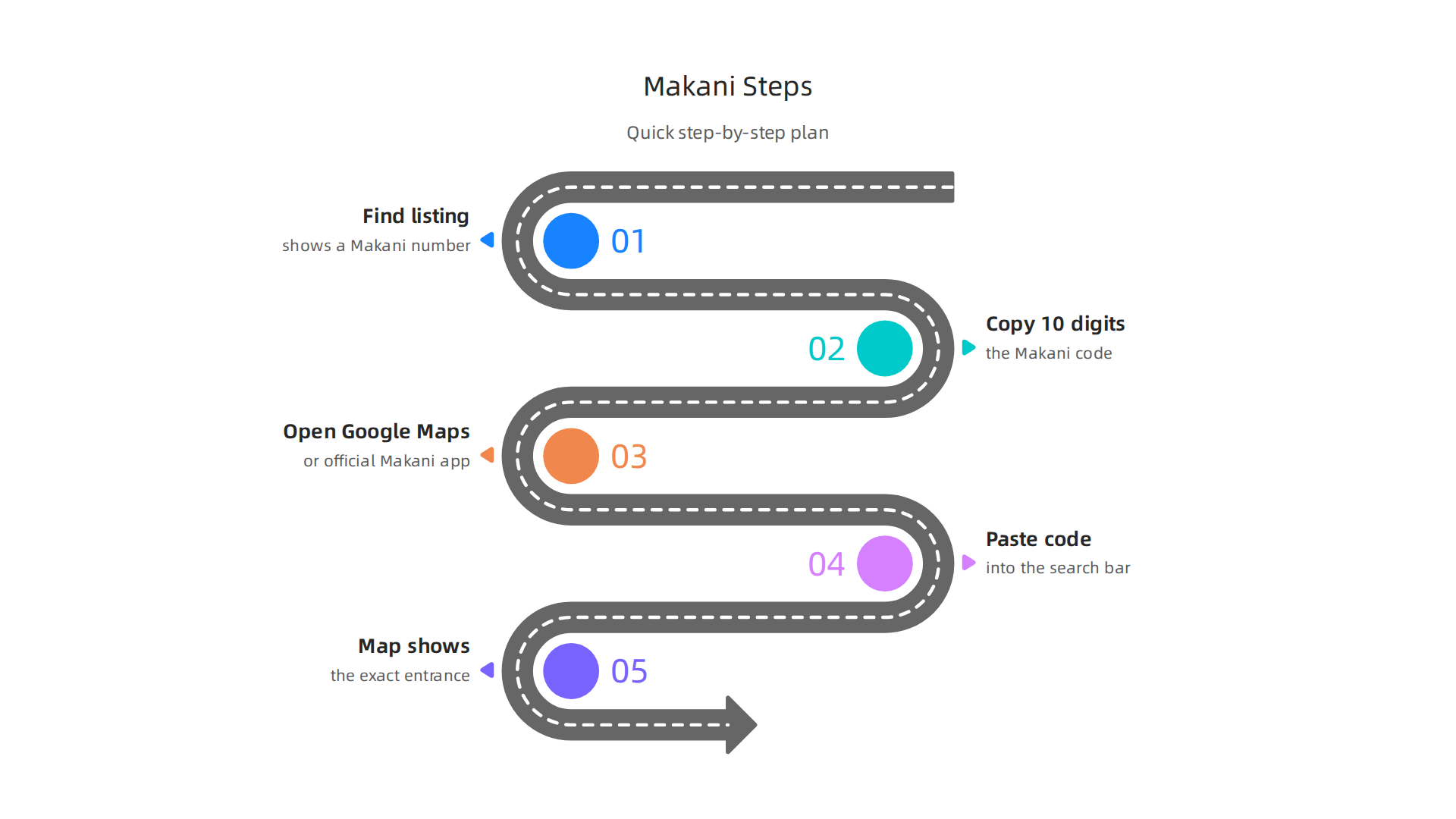
That is all it takes. No more driving in circles. No more confusing directions. Just a precise location every single time. This simple tool can save you hours of frustration and help you make smarter property decisions from day one.
Advanced Search Features: Filters, Alerts, and Map‑Based Search
You now know exactly how to find a property door‑to‑door using a Makani number. But first you need to find the right property. That is where modern search tools make all the difference.
The top real estate platforms today offer far more than a simple listing feed. They give you granular filters that cut through the noise.
Think about it. You can narrow down results by price range, unit type (studio, one‑bedroom, penthouse), furnishing status, handover date, and even how close the property is to specific landmarks. According to a detailed guide on advanced property search, these multiple filter options are one of the core features that make real estate apps powerful and user‑focused Read the full explanation on advanced property search features.
But filters are just the start. Saved search alerts are a game‑changer for busy buyers and investors. You set your ideal criteria once. The platform watches for new listings automatically. The moment something matches, you get an instant notification. No more refreshing pages or missing hot deals. As the Property Finder app description notes, their smart filters match what really matters: location, budget, lifestyle, and commute See the Property Finder app features on Google Play.
Then there is map‑based search. This is where everything comes together visually. Instead of scrolling through endless text listings, you see properties plotted right on a map. You can overlay community boundaries, school zones, public transport routes, and even commute times. This helps you see the bigger picture instantly. Top real estate websites in Dubai for 2026 highlight map‑driven browsing and interactive maps as key features that improve the search experience Check out the best real estate website examples for 2026.
Why does this matter for you? Imagine you are looking at apartments for sale in Business Bay. You can use map‑based search to see all available units in your preferred sub‑area. Then you apply filters for handover date and furnishing. Then you set an alert to notify you if a new listing drops. Finally, you use the Makani number from that listing to pinpoint the exact entrance. That is a complete workflow from discovery to doorstep.
These advanced features also help when exploring newer communities like Dubai Land or Arjan Dubai, where street names are rare. Map‑based search combined with saved alerts makes it simple to track opportunities across all emirates. If you are planning to invest beyond Dubai, check out our guide on investing across the emirates in UAE 2026 for a broader view of the market.
The bottom line? Modern search tools are built to save you time and help you decide with confidence.

Use the filters. Turn on the alerts. Explore the map. Then walk right to the door with your Makani number.
Evaluating Property Listings: What to Look for Beyond the Makani Number
So you have found a property using advanced filters, saved alerts, and map based search. You even have the Makani number Dubai to walk right to the door. That feels good. But here is the thing. A Makani number only tells you where a property sits. It does not tell you if the property is real, legal, or worth your money.
Before you get serious about any listing, you need to look deeper. Think of the Makani number as the address on an envelope. You still need to check what is inside.
The Three Non-Negotiables
Every listing you consider should pass three basic checks. First, a valid title deed must exist. This is the official document proving ownership. Without it, you cannot complete a sale. Second, the unit description must match reality. If the listing says three bedrooms but the floor plan shows two, walk away. Third, the imagery must be authentic. Beware of heavily edited photos or images that look like they came from a different building.
According to a detailed due diligence guide for Dubai property buyers in 2026, verifying the title deed and the seller’s identity is one of the first steps any serious investor should take Check out the Dubai property due diligence checklist for 2026. This kind of verification protects you from fraud and wasted time.
Cross-Reference the Makani Number with RERA
Here is a powerful move. Take the Makani number from the listing and use the Dubai Land Department or RERA database to verify the property details. You can check if the ownership matches the seller or agent making the claim. You can also see if there are any encumbrances. Encumbrances are legal claims or restrictions placed on a property, like unpaid loans or disputes.
The due diligence process for property in Dubai involves checking the legal status of the property, the developer history, and any existing restrictions Read more about due diligence in Dubai real estate investment. Cross-referencing the Makani number with official records is a simple way to start.
This step matters even more in communities like Dubai Land or Arjan Dubai, where newer developments may have incomplete records. A quick RERA check can save you from months of headaches.
Watch for Red Flags
Some listings look great but hide problems. Here are three red flags that should make you stop and investigate further:
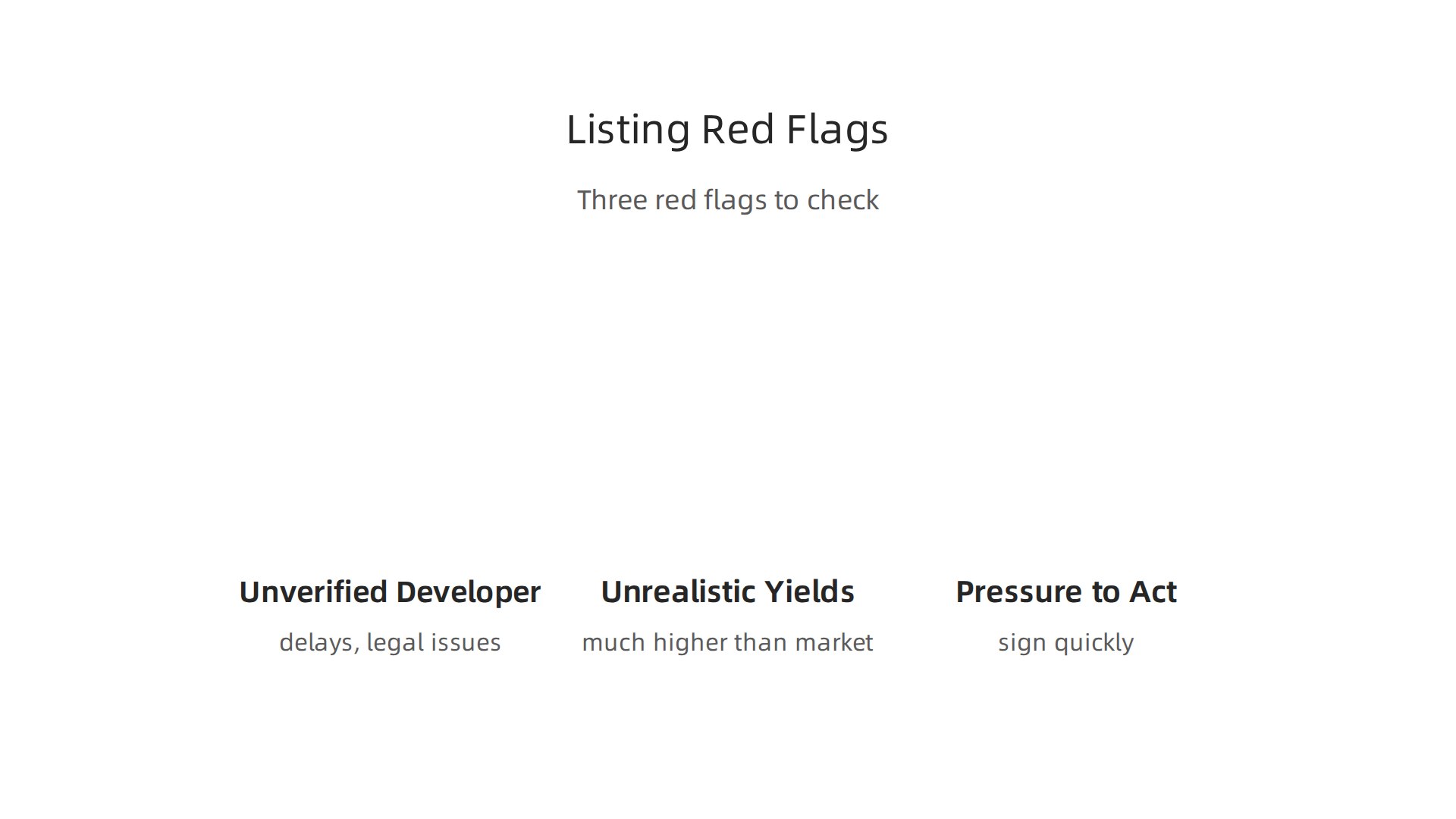
- Unverified developer history. If the developer has a track record of delays or legal issues, be careful. Dubai Law No. 4 of 2026 introduced stricter escrow obligations and clearer refund triggers for off plan buyers See the real estate law updates for 2026. But you still need to do your homework.
- Unrealistic rental yields. If a listing promises returns that are much higher than the market average, ask why. The Dubai housing market in 2026 shows stable but realistic growth Explore the Dubai housing market data for 2026. Yields that seem too good to be true usually are.
- Pressure to act fast. Genuine sellers and agents give you time to verify. If someone pushes you to sign quickly, that is a major warning sign.
Practical Next Steps
When you find apartments for sale in Business Bay or any other area, follow this simple process:
- Get the Makani number from the listing.
- Verify the property on RERA’s database.
- Check the title deed and ownership.
- Compare the listing photos with the actual unit if possible.
- Ask for the developer’s track record.
If everything checks out, you can move forward with confidence. If something feels off, trust your gut and walk away. There are always more listings to explore.
For a complete understanding of the legal and financial side of buying property, check out our guide on how to get a business license in Dubai for real estate in 2026. It covers the regulatory steps you need to know.
The Makani number Dubai is a brilliant tool for finding your way. But it is just the start. Real confidence comes from verifying everything behind the listing.
Legal and Transactional Considerations When Using Online Tools
You have done the hard work. You verified the listing, checked the Makani number Dubai against RERA, and looked for red flags. But there is one more layer to think about. The legal side of using online tools.
How Online Tools Must Follow the Law
Every property platform you use in Dubai has rules to follow. The Dubai Land Department (DLD) and the Real Estate Regulatory Agency (RERA) set strict guidelines. These rules are there to protect you. They make sure the data you see is accurate and up to date.
For example, the Makani number itself is an official DLD tool. But not every website displays it correctly. Some sites might show a wrong number or a number that does not match the property. That is why you must verify the Makani number through official channels before you close any deal. Do not rely on the listing alone.
According to a detailed guide on buying property in Dubai for 2026, the due diligence process includes checking that the property title and ownership match the information provided online Read the full 2026 buying guide on GuestReady. This step is not optional. It is your safety net.
Why Professional Help Still Matters
Here is the truth. No matter how good the online tools are, they cannot replace a human expert. A real estate agent, a lawyer, or a licensed advisor can look at the same data you see and spot issues you might miss.

They can interpret the legal language on a title deed. They can check if there are any hidden encumbrances.
The real estate due diligence process for 2026 emphasizes that verifying the seller’s identity and the property’s legal status often requires professional expertise Check the due diligence checklist from Oliva. A small mistake in reading a contract or a missing document can cost you a lot.
Professional advisors also help you avoid contractual pitfalls. They know the latest laws, like Dubai Law No. 4 of 2026, which changed escrow rules and refund rights for off plan buyers See the 2026 real estate law updates from Global Law Experts. Without expert help, you might miss these important details.
Practical Steps for Safe Transactions
Here is a simple checklist to keep yourself protected when using online tools:
- Always verify the Makani number on the official DLD or RERA website before signing anything.
- Ask for a title deed copy and check the owner’s name matches the seller.
- Use a licensed agent or lawyer to review the contract and the property history.
- Never skip the professional advisory step. Even if the online data looks perfect, an expert can confirm it is real.
Learning about the regulatory side of real estate can also help you avoid problems. If you are planning to invest further or even start your own agency, our guide on how to get a business license in Dubai for real estate in 2026 explains the legal requirements you need to understand.
The Makani number Dubai is a powerful tool. But it is only one piece of the puzzle. Combine it with official verification and professional advice, and you will make safer, smarter decisions.
Summary
This article explains how Dubai’s 10‑digit Makani number system gives buyers and investors precise property locations and removes the guesswork of vague addresses. It covers what a Makani number is, which major apps and property portals integrate it (Property Finder, Bayut, DXBinteract), and simple steps to paste a Makani code into Google Maps or the official Makani app to pinpoint a building entrance. The guide also shows advanced search techniques—filters, saved alerts and map views—that speed up discovery, then outlines practical due diligence: verify Makani with RERA/DLD, check title deeds, confirm photos and developer history, and watch for common red flags. Finally, it stresses the legal side of transactions and why you should use licensed agents or lawyers to review contracts and encumbrances. After reading, you’ll know how to use Makani numbers in your property search, validate listings safely, and combine digital tools with professional checks to make smarter real estate decisions.